
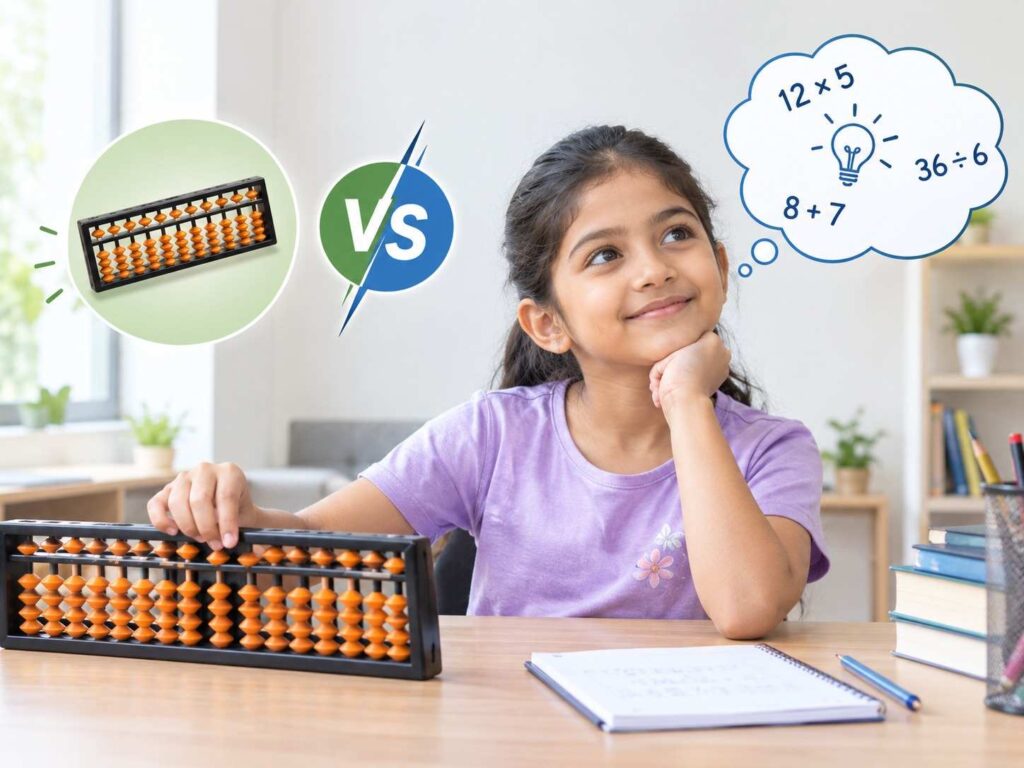
Maths is an essential part of a child’s education. However, learning maths will not have to be limited to memorising the formulas to solve problems from a textbook. Nowadays, parents have frequently looked for practical learning methods which will improve calculation speed, concentration, memory, and confidence. Two popular approaches are Abacus and Mental Maths.
Both methods have their own advantages. While abacus for children introduces numbers through a visual and hands-on approach, mental maths for kids focuses on solving calculations mentally without depending on physical tools. Understanding how each method works will help parents choose a suitable maths training for children that is based on their age, learning style, and requirements.
What Is Abacus Maths?
The abacus is a traditional calculating tool made with a rod or wire and movable beads. Children learn to move these beads, which will help them understand numbers, addition, subtraction, multiplication, division, and finally make advanced calculations.
In abacus maths, children initially perform calculations using a physical abacus. Once they become familiar with the bead movements, they will gradually learn to imagine the abacus in their minds. It is the visualisation that allows them to perform calculations more quickly without physically using the tools.
This makes abacus math for kids more than a method of calculation. Regular practice will also help children strengthen concentration, visualisation, memory, and number recognition.
As younger children often understand concepts better when they can see and touch what they are learning, an abacus will make the early stages of maths more engaging.
What Is Mental Maths?
Mental maths for kids consists of calculating math sums mentally, without the requirement of writing each step on paper or using any calculators.
In the case of calculating sums like 25+18 mentally, the calculation will be done in two steps:
25+10=35
35+8=43
Mental maths helps in the development of different approaches towards numbers for children. It not only requires them to perform operations through memorised methods but also helps them to understand how to decompose, regroup, approximate and compose numbers.
Good mental math skills have proven to be helpful in real-life scenarios, classroom settings, competitive exams, and occasions when children are required to calculate swiftly.
What Is the Difference Between Abacus vs Mental Maths?
Even though abacus and mental maths both aim to improve maths ability, their learning processes are different.
With abacus for children, students will begin with a physical learning tool. They will see that numbers are represented through the beads and use their hands to perform the calculations. As time passes, the physical movements will become mental visualisations.
Whereas mental maths basically starts directly with numbers and calculation strategies. Children will learn techniques like number splitting, grouping, estimation, doubling, halving, and recognising number patterns.
In simple terms, the abacus provides a visual route for mental calculations, whereas Mental maths teaches children to manipulate numbers directly in their minds.
Benefits of Abacus for Children
One of the major reasons why a parent should consider abacus math for kids is that it uses visual, physical, and mental learning.
Through the practice of abacus, the children will become comfortable with numbers from an early age. Moving beads will also create a more interactive learning experience compared with simply completing worksheets.
Regular abacus maths practice will support:
- Faster calculation skills
- Better concentration
- Number recognition
- Visualisation ability
- Improved memory
- Hand-eye coordination
- Confidence while solving calculations
For children who find traditional maths lessons difficult to learn and understand or uninteresting, the activity-based nature of the abacus will make learning more enjoyable.
Benefits of Mental Maths for Kids
The biggest advantage of mental maths for kids is its practical applications. Mental calculation will be used in every situation.
Children use mental maths to calculate money, understand discounts, estimate quantities, check answers, measure time, or solve problems during school examinations.
Mental maths will also help students understand relationships between members instead of treating maths as a collection of fixed rules.
Regular practice will improve:
- Calculation speed
- Number sense
- Logical thinking
- Problem-solving ability
- Estimation skills
- Mathematical confidence
- Ability to recognise patterns
Good maths classes for children will not only focus on the correct answer, but will also help students to understand how numbers work.
Which Is Better for Younger Children?
For a lot of young students, the abacus will be helpful to give them an understanding of concepts, as it will make numbers visible.
A child will not know the meaning of “ 7 minus 3” by just looking at the written numbers. But by taking away three beads from a total of seven, he gets a physical image of subtraction.
That’s the reason why the use of an abacus for children will be especially beneficial in the beginning stages of learning maths.
When the children gain confidence, the physical abacus will slowly be replaced by mental visualisation.
Which Is Better for Older Children?
When the children are older and already have the knowledge of fundamental maths operations, then mental maths becomes very helpful. While working out more complicated sums, students frequently require fast calculations. The practice of mental maths will save them time, which will be used for solving more difficult sums.
The method of structured maths training for children does involve calculation along with reasoning and problem-solving skills.
Instead of considering abacus and mental maths as rival approaches, parents will think of them as complementary ways of learning.
Is It Possible to Learn Abacus and Mental Maths?
Yes, in fact, studying both will be the best option to create balance in the process of math development. Abacus maths will help develop very good visualisation and computing skills at a young age. And mental maths will improve skills by allowing kids to manipulate numbers in flexible ways.
The child who has the ability to visualise numbers and manipulate them will surely be able to face all kinds of maths questions in a relaxed manner.
Selecting the Best Maths Classes for Kids
When parents are searching for the best maths classes for kids, calculation speed will not be the only consideration. A good learning programme will encourage children to understand maths, practise regularly, ask questions, and become independent problem-solvers.
At Winskill Academy, the focus is to create a supportive learning environment where children will strengthen their maths skills through structured guidance and regular practice.
Maths classes for children will be customised to their own present capabilities, and not impose undue stress on them. If maths-related tasks are done in a gradual manner, children will participate in the process without any hesitation.
What will Parents Select? Abacus or Mental Maths
There is no single method which is the perfect choice for every child. For younger children who will enjoy the interactive and visual activities, abacus math for kids will be a useful starting point. It helps them to experience numbers physically before proceeding to mental calculation.
For children who are already comfortable with basic maths, mental maths for kids will help them to develop faster calculation, stronger number sense, and better problem-solving skills.
Parents will also have the option of selecting programmes that will offer a combination of both. The ultimate aim of maths for children will not be to make them quick at calculation but to help them to understand numbers, develop confidence in maths and become comfortable with calculations.
Conclusion
Abacus and Mental Maths are both effective methods of developing mathematical skills in a person. Abacus maths uses a more visual approach and can be helpful for young children, whereas Mental Maths requires the child to be able to solve math problems on his or her own.
The question of whether one method is better than another should not even be considered; parents need to choose the method according to their child’s learning stage and skills.
If children regularly practice and get proper assistance in solving various mathematical problems, along with interesting and encouraging maths lessons for children, children will definitely develop their mathematical skills. Children at Winskill Academy are provided with such a learning environment.
FAQs
1. What age is best for learning abacus?
Abacus for kids can be learnt by children who have already mastered an elementary idea about counting and numbers. However, the most suitable age will depend on the learning capability of each child.
2. Is Abacus helpful for Mental Maths in children?
Yes. In the course of Abacus maths training, children slowly learn to visualise the movement of beads in their mind. With consistent practice, visualisation could be useful in performing mental calculations without using the physical instrument anymore.
3. Are Mental Maths useful for school-going children?
Yes. Mental maths for kids can help them perform calculations quickly, make estimations, comprehend number relations and solve math problems of daily life. Moreover, mental maths for kids can make basic calculations easy in school studies and exams.
4. How do I select the best math classes for my child?
When choosing the best maths classes for kids, you should take into account the age of the child, his level of maths skills, the approach to teaching maths for kids, the classroom environment and possibilities for regular practice. Winskill Academy concentrates on systematic learning, which will help children develop their skills progressively.