
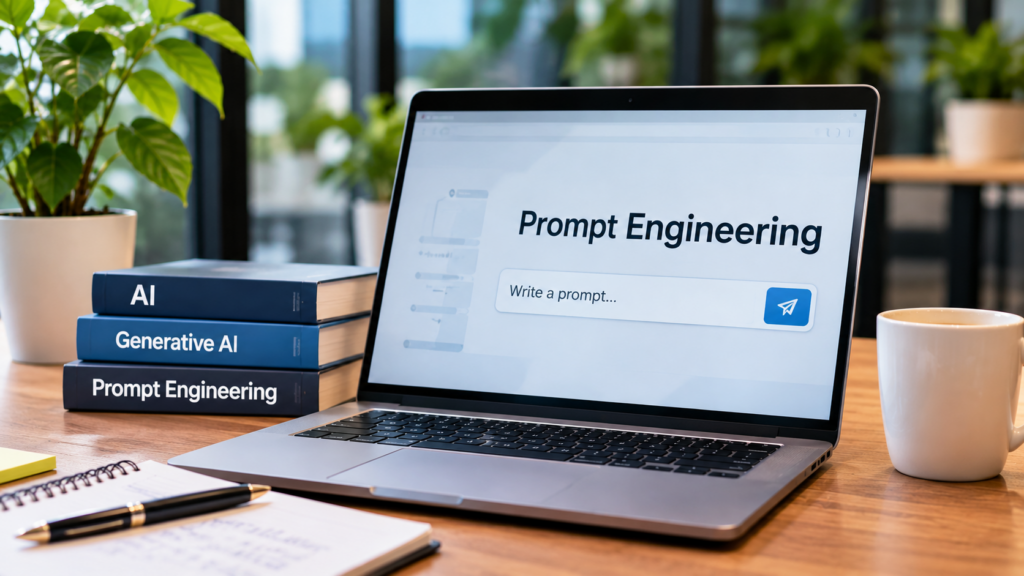
Artificial Intelligence (AI) is quickly changing how people study, work, create content, analyse information, and solve everyday problems. Tools like ChatGPT and other AI platforms can generate text, images, ideas, reports, presentations, and even code in seconds. But the quality of the result often depends on one important factor like how clearly you communicate with the AI.
This is where prompt engineering becomes important. Learning prompt engineering will help students, professionals, business owners, marketers, developers, and beginners to use generative AI more effectively. At Winskill, learners will gain practical AI skills. These skills will help them to communicate with AI tools more clearly and get useful, accurate and relevant outputs.
What Is Prompt Engineering?
Prompt engineering is the process of designing or refining prompts for an AI model. In my opinion, it requires an initial understanding that a prompt is nothing but the input text that we use. The more detailed the prompt is, the better results we will get. A very basic prompt could state that the AI must write a social media post, which is far too general.
If we add some details to it, such as the number of words required or the target audience, we will give additional information for the AI to use. For example, one variant says that the post should be professional on LinkedIn, aimed at small business owners regarding digital marketing advantages and written in simple language.
I feel like this approach determines the main success factor. However, there are still many things about the reason behind this particular behaviour of AI that remain unknown to me.
Why Is Prompt Engineering Important?
AI tools will not automatically know exactly what a user wants. They are generated based on the responses, which are based on the instructions and context they have received. Good prompts will help to improve the accuracy, relevance, structure, and usefulness of the AI-generated responses.
Developing strong AI skills will therefore help users save time by performing tasks like writing content, researching ideas, summarising information, planning projects, analysing data, preparing presentations, and brainstorming business strategies.
Since generative AI is becoming more common in education and professional environments, that helps to understand how to communicate with AI will become a valuable digital skill.
The structured prompt engineering course will help learners understand how these prompts work and how different instructions influence AI-generated results.
How to Write Better AI Prompts
Creating an effective prompt will not always require technical knowledge. Ther are many cases where you will improve AI responses by following some basic principles.
- Be Clear About the Task: Start with a clear explanation of what you want to do with AI. Instead of writing, “explain marketing.” you may try writing, “ Explain digital marketing in simple language for a beginner in 200 words only.” A specific instruction helps to reduce uncertainty and helps AI understand your objectives.
- Provide Relevant Context: Context helps generative AI to understand the situation behind your request. For example, “You are helping a small clothing business improve its Instagram presence. Give me a suggestion of 5 content ideas targeting people aged 18 to 30.” Here, AI understand the business type, platform, objectives and the target audience.
- Define the Desired Format: You will tell the AI the right command for how you want the answer to be presented. For example, “ Create a table with a three-columns which are strategy, benefits, and example.” or “Explain the topic using five bullet points.” Providing formatting the instruction as the vital part of prompt engineering since it makes the outputs easier to use.
- Mention the Tone: The same information will be written in many various ways. It depends on your requirements; you will ask the AI to use a professional tone, friendly tone, educational tone, conversational tone, and simple beginner-friendly tone. For example, write a professional but friendly email to remind a client about the upcoming meeting.
- Create Limitations: Creating boundaries will make the AI response more will the response of the AI morefocused. You may ask, “The answer should be under 150 words.”, or “try not to use any technical terms, ” or “give only three examples. “. All of these instructions will prevent uncertainty and long or complicated responses.
- Important Prompt Engineering Techniques: A good prompt engineering course will introduce many prompting techniques which will might be used based on the complexity of the task.
- Zero-Shot Prompting: Zero-shot prompting helps to give AI a direct instruction without giving examples. For example, “Write five interview questions for a digital marketing executive.” It is appraoch which works well for straightforward tasks
- Few-Shot Prompting: Few-shot prompting basically provides examples before asking AI to generate a new result. For example, you will provide two sample product descriptions and then ask AI to create one more description using a similar structure.
- Step-by-Step Reasoning: For complex tasks, breaking the problem into smaller stages will also improve the quality of the final results. Instead of asking the AI to complete the complicated project in a single instruction, you may divide it into steps like research, outlining, writing, reviewing, and improvement. This is an approach useful for creating practical AI skills.
- Prompt Chaining: Prompt chaining means the use of different connected prompts for completing a large task. For example, you will first ask the AI tool to generate a blog idea, then create the outline, then write an article, and finally optimise the content for SEO. Breaking larger tasks into smaller instructions will improve consistency and will make the workflow easier to manage.
Prompt Engineering for Different Fields
Prompt engineering will be applied in many industries and professions. Students will use AI to understand difficult concepts, create study notes, generate practice questions, and organise assignments. Marketing professionals will use generative AI for campaign ideas, social media content, keyword research, ads, and content planning. Business owners will use AI for email writing, customer communication, marketing research, presentations, and business planning.
Developers will use AI for understanding code, troubleshooting problems, generating documents, and brainstorming solutions. Designers and content creators will use prompts to generate creative concepts, visual ideas, scripts, captions and storyboards. With these applications, learning AI skills will support many different career paths.
Why Learn Prompt Engineering at WinSkill?
Technology is changing at a quick pace. Knowing how to use AI effectively will help learners to become more confident in modern digital environments.
At WinSkill, we focus to get places on practical learning rather than only theoretical concepts. A prompt engineering course does help learners to understand how AI tools respond to instructions, how to create structured prompts, how to refine results, and how to use AI responsibly for real-world tasks.
Learners will practice creating prompts for content writing, research, communication, brainstorming, data-related tasks, and professional productivity. The goal is not simply to learn how to type questions into the AI tool. The goal is to develop useful AI skills that help learners to think clearly, communicate requirements effectively, and use generative AI as a practical productivity tool.
Conclusion
The use of AI is expected to continue to expand across education, business, marketing, software development, research, design, and communication.
Future AI systems will increasingly work with text, images, audio, video, and data together. This means users will need to understand how to give clear instructions across different formats.
Whereas AI tools will become easier to use, the ability for clear definition of task, provide relevant context, evaluate outputs, and refine instructions will continue to the valuable poart.
Learning prompt engineering at present will be helpful to help learners prepare for the increasingly AI-supported workplace.
FAQs
1. What is prompt engineering in simple words?
Prompt engineering is writing clear and structured instructions for AI tools so that they will generate right, relevant, and useful responses.
2. Will I require knowledge of coding to learn prompt engineering?
No, prompt engineering does not require programming knowledge. Many AI tools use natural languages that means you will communicate with them using normal written instructions.
3. Who will take a prompt engineering course?
The prompt engineering course will be for students, job seekers, teachers, marketers, business owners, content creators, developers, and professionals who want to improve their AI skills and use generative AI in an effective way.
4. How will prompt engineering help to make career?
Learning prompt engineering will help professionals use AI for research, communication, content creation, planning, analysis, automation, brainstorming, and productivity. Creating strong AI skills will also help learners to become more prepared for the workplace, where generative AI tools are increasingly used.